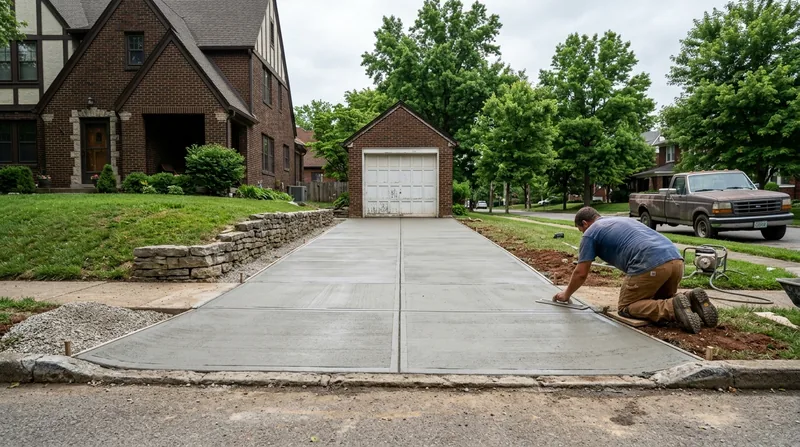




Lexington sits on deep red-brown silt loam over clayey subsoil and shallow Ordovician limestone bedrock, creating a karst landscape where concrete slabs and foundations face real challenges. Sinkholes and soft spots can undermine slabs, while clay that swells in wet weather and settles in dry spells causes walkways, porch steps, and driveway panels to sink and tilt over time. Whether you're adding a garage to a 1920s Tudor in Chevy Chase, pouring a foundation for a room addition on a 1950s brick ranch in Gardenside, or laying a shed slab on a newer subdivision home near Masterson Station, the concrete work has to account for Lexington's freeze-thaw cycles, de-icing salt damage, and unpredictable drainage patterns. We pour engineered slabs with proper base preparation, steel reinforcement, and thickness designed to handle the local soil and climate. A solid foundation starts with understanding the ground beneath it.
Why Concrete Slabs & Foundations Matter in Lexington's Climate and Terrain
Lexington's winters bring dozens of freeze-thaw cycles each year, plus road salt and driveway de-icing chemicals that accelerate surface scaling and spalling on concrete. Summer thunderstorms test grading and drainage, and the region's soft limestone bedrock means settlement cracks and heaving are common if the base isn't compacted correctly. A properly engineered slab with reinforced steel, adequate thickness, and a compacted base layer resists these pressures far better than a thin, poorly prepared pour. Skipping the foundation work now means costly repairs, sinking structures, and water intrusion later.
- We compact the subgrade to eliminate soft spots and voids that allow settlement under freeze-thaw stress.
- We specify steel reinforcement and proper slab thickness based on soil bearing capacity and intended load.
- We grade and drain the site to shed water away from the foundation and prevent pooling around the perimeter.
- We pour at the right air temperature and finish the surface to resist salt scaling and surface spalling.
- We use local expertise on Lexington's limestone and clay to design foundations that stay level and dry.
A well-built slab is an investment in stability, durability, and peace of mind in Lexington's challenging soil and climate.
Key info: Lexington's karst bedrock means sinkholes and subsurface voids are a real risk. Before we pour any large slab, we evaluate the site for soft spots and recommend soil testing if the terrain suggests past settlement. This step saves thousands in repairs later.
For more on how soil and climate affect concrete durability in Kentucky, see the University of Kentucky's resources on regional geology and construction.
How We Build Concrete Slabs & Foundations in Lexington: Step-by-Step
Our process starts with site assessment and ends with a finished slab that will handle Lexington's soil movement and weather for decades. We evaluate the terrain, check for soft spots or drainage issues, and design the slab thickness, reinforcement, and base prep to match the load and local conditions. Every pour is tailored to the job, not a one-size-fits-all approach.
- We conduct a site inspection to identify soft soil, drainage problems, or subsurface hazards that might affect the foundation.
- We remove topsoil and organic material down to stable subgrade, then compact the base in lifts to eliminate voids.
- We place a gravel or crushed-stone base layer, compacting it to the specifications required for the slab load and local soil type.
- We set up forms, grade the site for proper drainage slope, and install steel reinforcement (rebar or wire mesh) as designed.
- We pour the concrete at the right temperature, finish the surface for traction and drainage, and cure it properly to resist freeze-thaw damage.
- We strip forms, backfill around the perimeter, and grade away from the slab to keep water moving away from the structure.
The result is a level, durable foundation that won't settle, crack, or heave under Lexington's seasonal stress.
Local example: A homeowner in Hartland needed a 20-by-24-foot garage slab on clay subsoil prone to settling. We excavated 18 inches, placed 6 inches of compacted gravel base, poured a 5-inch slab with #4 rebar on 18-inch centers, and sloped it 1/8 inch per foot away from the garage. Two years later, no cracks, no settlement. That's what proper foundation work looks like.
Learn more about our approach to site preparation and drainage on our concrete repair and resurfacing page, where we address the damage that poor base prep causes.
Concrete Slab & Foundation Methods: Choosing the Right Approach
| Approach | Description | Best for |
|---|---|---|
| Slab-on-grade with reinforced base | Standard 4-to-6-inch poured concrete with steel reinforcement, 4-to-6-inch compacted gravel base, proper slope for drainage. | Garages, sheds, room additions, patios. Most common in Lexington residential work. |
| Post-and-pier foundation | Concrete piers set below frost line (3 to 4 feet in Lexington), supporting posts or beams above grade. No slab. | Decks, porches, additions where frost heave risk is high or grade is uneven. Protects against seasonal movement. |
| Engineered footing with stem wall | Deep concrete footing below frost line, with a concrete stem wall above grade. Combines slab and foundation in one unit. | New construction, additions with basements or crawl spaces, structures requiring structural separation from grade. |
| Thickened-edge slab | Standard slab with thickened perimeter (8-to-12 inches) to distribute load and resist frost heave at edges. | Garages and structures on clay soils prone to frost heave. Common in Lexington for added durability. |
| Moisture barrier and radon control | Vapor barrier or radon mitigation layer beneath slab to reduce moisture intrusion and radon gas migration into structures. | Basements, crawl spaces, additions where moisture or radon is a concern in Lexington's limestone terrain. |
Concrete Slabs & Foundations Cost in Lexington: What to Expect
Concrete slabs and foundations in Lexington typically start at $5 per square foot for a standard slab-on-grade with basic base prep and reinforcement. A typical 20-by-24-foot garage slab (480 square feet) runs $2,400 to $3,600 depending on site conditions, base prep complexity, and whether you need thickened edges or special drainage. Costs climb if the site has soft soil, poor drainage, or requires extra excavation to reach stable subgrade. Steel reinforcement, thickened edges for frost heave protection, and proper grading add to the total. Getting 2 to 3 estimates from insured contractors is the only way to know the real cost for your property and soil conditions.
Site access, existing grade, and soil type are the biggest cost drivers. A level, well-drained site with stable soil costs less than one with soft spots, poor drainage, or extensive excavation needed. Larger projects (1,000+ square feet) may see per-square-foot savings. For a detailed breakdown of pricing and factors specific to your job, visit our pricing page or call us at (859) 710-6168 for a free estimate.
Concrete Slabs & Foundations Near Me: What to Look for When Hiring a Contractor in Lexington
Finding the right contractor for your foundation work means checking three things: insurance coverage, references from recent Lexington jobs, and a clear understanding of permits and site conditions. Never hire based on price alone, and always get the estimate in writing with a detailed scope of work. A contractor who asks questions about your soil, drainage, and the structure's intended use is doing the job right. One who quotes a price without seeing the site is cutting corners.
- Verify general liability and workers compensation insurance with a current certificate of insurance on file before any work starts.
- Ask for references from homeowners in Lexington, Nicholasville, or Versailles where the contractor has poured slabs or foundations in the last two years.
- Confirm that the contractor understands local permits for excavation, fill, and foundation work, and will pull them if required by your city or county.
- Check whether your HOA or neighborhood has setback, drainage, or design restrictions that affect the slab layout and must be approved before the pour.
- Get a written estimate that specifies slab thickness, base prep depth, reinforcement type, and any site-specific work like drainage or soft-spot remediation.
- Ask about the curing process and any restrictions (like no heavy loads or water) for the first week after the pour.
A professional contractor will take time to understand your site and explain why the design matters, not rush through a quote and start digging.
Ready to discuss your slab or foundation project? Contact us for a free, no-obligation estimate or call (859) 710-6168. We'll visit your site, assess the soil and drainage, and give you a clear price and timeline.
Concrete Slabs & Foundations in Lexington: Pricing Guide
| Service | Price | Details |
|---|---|---|
| Standard slab-on-grade | Starting at $5/sq ft | Includes base prep, compacted gravel, steel reinforcement, 4-to-6-inch pour, and proper slope for drainage in Lexington soil |
| Thickened-edge slab for frost heave | Starting at $6.50/sq ft | Thickened perimeter (8 to 12 inches) to resist frost heave on clay soils common in Lexington neighborhoods |
| Post-and-pier foundation | Starting at $40 per pier | Concrete piers set below Lexington frost line (3 to 4 feet), ideal for decks and additions on uneven terrain |
| Site with soft spots or poor drainage | On estimate | Requires soil testing, extra excavation, or remediation before pouring. Site assessment determines final cost and method |
| Travel and estimate | Included in Lexington area | Free on-site estimate, response within 24 hours, no obligation to book, travel included in Lexington service area |
Indicative pricing, the exact cost depends on square footage, finish, and site access. Free personalized estimate within 24h at (859) 710-6168.


